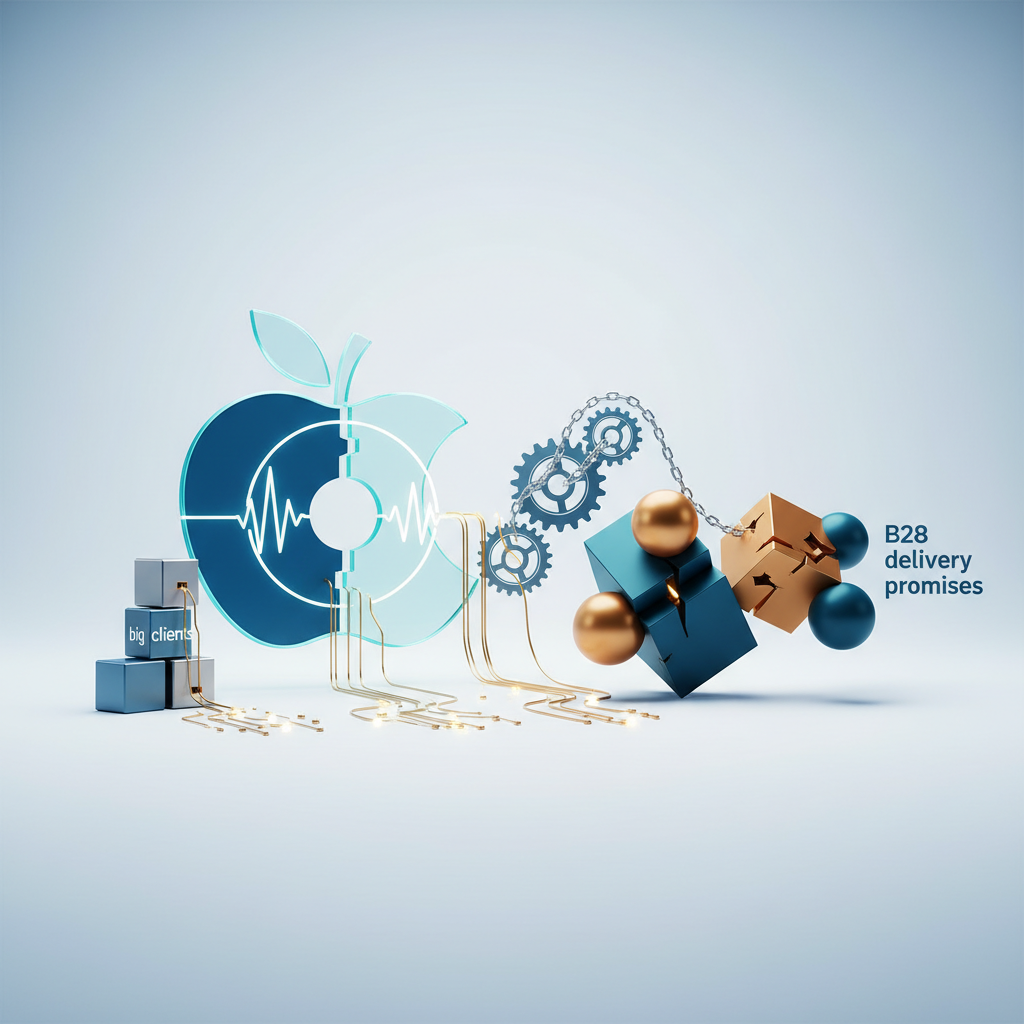
By Collecty Research | Forensic Series: The Giant Client Trap
Reading time: 8 minutes
On February 11, 2026, Bloomberg reported that Apple's highly anticipated Gemini-powered Siri upgrade has been delayed again. The AI-enhanced voice assistant was originally slated for March 2026 (iOS 26.4), then pushed to May 2026 (iOS 26.5), and now may not arrive until September 2026 (iOS 27).
Apple's stock briefly dipped on the news, then recovered. By week's end, Apple was up 7% — its best weekly performance in six months.
Analyst Gene Munster (Deepwater Asset Management) summed it up: "This highlights the 'low bar' investors have for Apple."
Translation: Nobody expects Apple to deliver AI features on schedule anymore. The market has accepted broken timelines as normal.
For B2B suppliers, this is a familiar pattern — but with a critical difference. When Apple delays deliverables and stakeholders shrug, Apple wins. When your client delays payment and you shrug, you lose.
This is the story of how big clients normalize failure, and why small suppliers can't afford to accept it.
The Timeline of Broken Promises
December 2025: The Announcement
Apple announced a partnership with Google to integrate Gemini AI into Siri. The upgrade would bring:
- Contextual understanding across apps
- Multi-step task automation
- Natural language processing that actually works
- Integration with third-party services
Timeline: March 2026 with the iOS 26.4 update.
Investors loved it. The stock rallied. Apple's "AI strategy" narrative was validated.
January 2026: Internal Doubts
Behind the scenes, Apple engineers were struggling. According to Bloomberg sources:
- Integration testing revealed "fresh problems"
- The software wasn't stable enough for public release
- Timelines started slipping internally
Publicly, Apple said nothing. March remained the target.
February 2026: The First Public Delay
February 8, 2026: Mark Gurman (Bloomberg) reported that the March timeline was "no longer realistic." Apple was now targeting May 2026 (iOS 26.5).
Market reaction: Stock dipped 1.5%, recovered the same day.
February 11, 2026: The Second Delay
Bloomberg reported that even May is "fluid." Some features may not arrive until September 2026 (iOS 27) with the annual iPhone software update.
Reasons cited:
- "Testing uncovered fresh problems"
- "Software not ready for prime time"
- Executives "reluctant to delay further" (but delaying anyway)
Market reaction: Stock dipped 0.5%, then rallied. Ended the week up 7%.
Why Investors Don't Care Anymore
The Normalization Cycle
Apple has trained the market to accept delays through repetition:
This is trained helplessness — the market has learned that complaining about Apple's AI delays is pointless, so they've stopped.
The "Low Bar" Phenomenon
Gene Munster's comment — that investors have a "low bar" for Apple — is profound. It means:
- Expectations are reset: Investors no longer expect Apple to deliver on announced timelines
- Narrative trumps execution: The story of AI capability matters more than actual AI capability
- Scale provides immunity: Apple is so large and entrenched that missed deadlines don't materially impact the business
- Alternatives don't exist: iOS users aren't switching to Android over Siri delays
For Apple, this is a competitive advantage. For suppliers to Apple (or any large client), this is a warning.
The B2B Parallel: When Your Client Pulls an Apple
Every B2B supplier has dealt with a client like this:
The Pattern
Month 1: "We'll pay Net 30."
- Invoice sent: $50K
- Expected payment: 30 days
- Actual payment: 45 days
- Your response: Call accounts payable, get vague promises
Month 2: "We'll pay by end of month."
- Invoice sent: $50K
- Expected payment: 30 days (based on past promise)
- Actual payment: 60 days
- Your response: Escalate to manager, get "processing" excuses
Month 3: "We're working on it."
- Invoice sent: $50K
- Expected payment: Who knows at this point
- Actual payment: 90 days
- Your response: You've stopped pushing hard because it's exhausting
Month 4: "Net 60 is our new standard."
- Client unilaterally changes terms
- You accept because fighting hasn't worked
- Payment delays are now normalized
- You've been trained to accept what you wouldn't have accepted in Month 1
This isn't resolution. It's normalization through attrition.
Why Apple Can Get Away With It (And Your Client Can't)
Apple's Advantages
1. Scale
Apple is a $3 trillion company. Siri delays don't materially impact iPhone sales (which are still strong) or services revenue (which is growing).
2. Ecosystem Lock-In
iOS users aren't switching to Android because Siri is delayed. Their apps, data, and devices are all integrated. Switching cost is too high.
3. No Viable Alternatives
For premium smartphones in the U.S., it's iPhone or Galaxy. Siri delays don't make Galaxy suddenly better.
4. Narrative Power
Apple can sell "AI optionality" — the promise that AI features will eventually arrive and drive upgrades. Investors buy the narrative.
5. Stakeholder Patience
Apple's shareholders are largely passive (index funds) or long-term believers (retail investors who've made money for years). They tolerate delays.
Your Client's Disadvantages
1. Scale
Your client is not Apple. Their market cap is measured in millions, not trillions. Missed deliverables and payment delays materially harm operations.
2. No Lock-In
You're not locked into their ecosystem. You have alternative clients. You can (and should) diversify.
3. Viable Alternatives
Unless your client is a monopoly in their market (unlikely), competitors exist. You can find new clients.
4. No Narrative Power
Your client can't sell you "payment optionality" — the promise that they'll eventually pay. You need cash flow, not promises.
5. Stakeholder Pressure
You (the supplier) are a stakeholder who can apply pressure. If you stop delivering, they feel it immediately.
Red Flags That Your Client Is Pulling an Apple
Apple: "Testing uncovered fresh problems."What it means: We don't want to tell you the real issue. Your client: "We're working on releasing your payment."What it means: We prioritized other expenses and you're not urgent. Action: Demand specifics. "What specifically needs to happen for payment to be released? Who is responsible? When will it be resolved?"
What B2B Suppliers Should Do
When a Client Starts Delaying
First Delay (e.g., Net 30 becomes 45):
- Call immediately
- Document the conversation
- Confirm new payment date in writing
- Flag the account internally
Second Delay (e.g., 45 becomes 60):
- Escalate to management level
- Put future shipments on credit hold
- Request partial payment or deposit for new orders
- Consider engaging a collection specialist
Third Delay (e.g., 60 becomes 90+):
- Stop new deliveries
- Formal demand letter
- Engage B2B debt collection firm
- Consider legal action
Never reach Month 4 (where you've normalized the delays). By then, you've lost leverage.
Payment Terms Best Practices
- Net 15 for new clients (not Net 30 or Net 60) until trust is established
- Deposits for large orders (30-50% upfront)
- Progress payments for long-term projects
- Late payment penalties in contract (e.g., 1.5% per month)
- Right to suspend service for non-payment
When to Walk Away
If your client:
- Consistently pays 60+ days late
- Gives vague reasons for delays
- Expects continued delivery despite non-payment
- Shows no willingness to improve
- Has normalized delays and expects you to accept them
The revenue isn't worth the cash flow destruction and operational stress.
The Bottom Line
Apple can delay Siri and face no real consequences because it's Apple. The ecosystem lock-in, scale, and lack of alternatives insulate them from accountability.
Your client is not Apple.
When your client delays payment and you accept it, you're not being "understanding" or "flexible" — you're training them to exploit you.
Don't normalize broken promises just because the other party is big.
Apple's stock is up 7% despite missing another deadline. Your receivables won't magically appreciate in value just because you're patient.
Set boundaries. Enforce terms. Don't mistake size for reliability.
Because when a $3 trillion company can't deliver on Siri, what makes you think your $50 million client will deliver on their payment?
Client keeps delaying payment? Collecty specializes in B2B debt recovery from companies that have normalized non-payment. 80%+ success rate. 160+ countries. No win, no fee. Free case assessment →
Sources
- Bloomberg: "Apple's latest attempt to launch new Siri runs into snags" - Mark Gurman (February 11, 2026)
- TechCrunch: "Apple's Siri revamp reportedly delayed... again" (February 11, 2026)
- 9to5Mac: "Apple pushing back Gemini-powered Siri features beyond iOS 26.4" (February 11, 2026)
- Benzinga: "Gene Munster says Apple stock sliding after new Siri delay highlights the 'low' bar investors have" (February 11, 2026)
- Investing.com: "Apple stock pares gains after reports of Siri upgrade delays" (February 11, 2026)
- StockTwits: "Apple stock loses retail euphoria after blowout earnings" (February 8, 2026)

Sarah Lindberg
International Operations Lead
Sarah coordinates our global partner network across 160+ countries, ensuring seamless cross-border debt recovery.