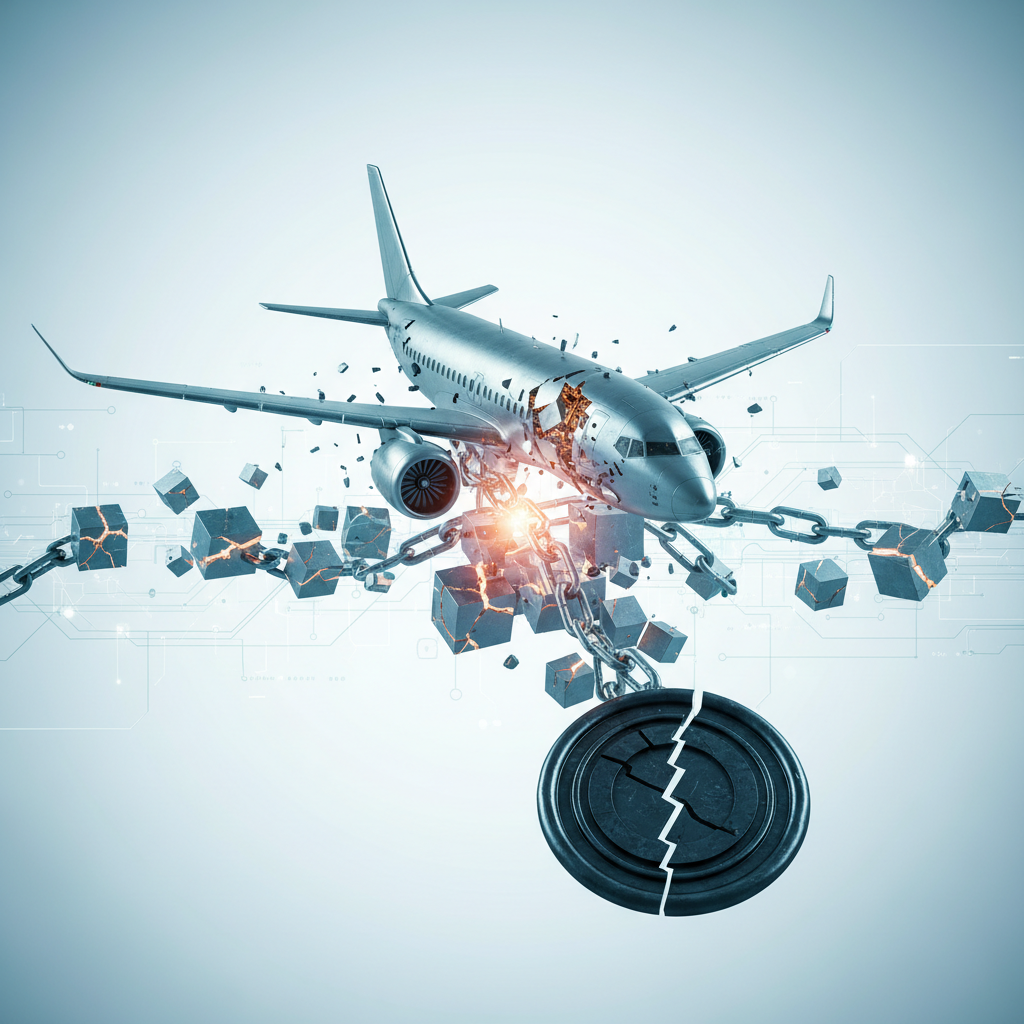
By Collecty Research | Forensic Series: The Giant Client Trap
Reading time: 8 minutes
On March 10, 2019, Ethiopian Airlines Flight 302 crashed six minutes after takeoff, killing all 157 people on board. It was the second fatal crash of Boeing's 737 MAX in five months. Within days, every 737 MAX in the world — 387 jets — was grounded. They wouldn't fly passengers again for 20 months.
The cost to Boeing: $19 billion. The cost in lives: 346 people. The root cause: a software system called MCAS that Boeing's own engineers knew was dangerous, that pilots weren't trained on, and that airlines could pay extra not to have safety features for.
This isn't a story about aviation. It's a story about what happens when a company prioritizes delivery schedules and profit margins over everything else — and what that means for everyone in their supply chain.
The Pressure: Airbus Was Winning
In 2010, Airbus announced the A320neo — a fuel-efficient upgrade to its best-selling narrow-body jet. Airlines loved it. Orders poured in. Boeing had a problem: its 737 was falling behind.
Boeing had two options:
- Design an all-new aircraft (the right choice, but 8-10 years of development)
- Retrofit the existing 737 with bigger, more efficient engines (fast, but risky)
Boeing chose option 2. The deadline pressure was immense. American Airlines was ready to order hundreds of A320neos. Boeing promised them a re-engined 737 instead — and promised it would require minimal pilot retraining to keep costs low.
That promise would be the foundation of the disaster.
The Design Flaw: MCAS
The bigger engines changed the 737's aerodynamics. In certain conditions, the nose could pitch up unexpectedly. Boeing's solution: MCAS (Maneuvering Characteristics Augmentation System) — software that would automatically push the nose down when it detected a stall risk.
The problems:
1. Single Point of Failure
MCAS relied on a single angle-of-attack sensor. If that sensor malfunctioned, MCAS would receive false data and force the plane into a dive — repeatedly, overriding pilot inputs.
2. Pilots Weren't Told
Boeing didn't include MCAS in the pilot manuals. Pilots flying the 737 MAX had no idea the system existed. When it activated unexpectedly, they didn't know what was fighting them for control.
3. Safety Features Were Optional Upgrades
Boeing charged extra for the disagree light — an indicator that would alert pilots if the two angle-of-attack sensors disagreed. Lion Air didn't buy it. Ethiopian Airlines didn't buy it. Both planes crashed.
4. Internal Warnings Were Ignored
Boeing's own test pilots and engineers raised concerns. Internal emails later released showed employees mocking the FAA, joking about deceiving regulators, and admitting the plane was "designed by clowns, who in turn are supervised by monkeys."
Boeing moved forward anyway.
The Crashes
Lion Air Flight 610 — October 29, 2018
Thirteen minutes after takeoff from Jakarta, the plane crashed into the Java Sea. All 189 people on board died. Investigators found that a faulty angle-of-attack sensor triggered MCAS, which forced the nose down 26 times. The pilots fought the system until they ran out of altitude.
Ethiopian Airlines Flight 302 — March 10, 2019
Six minutes after takeoff from Addis Ababa, the plane crashed. All 157 people died. The failure was identical: faulty sensor, MCAS activation, pilots unable to override.
The crashes were five months apart. Both were preventable. Boeing had the data from the first crash. They knew the problem. They did not ground the fleet.
The Fallout
March 13, 2019: Every 737 MAX worldwide is grounded. 387 jets. 59 airlines. The grounding would last 20 months — the longest in aviation history.
Financial Impact:
- $19 billion in direct costs (compensation, refunds, production halt, fixes)
- $2.5 billion criminal settlement with the U.S. Department of Justice
- Stock price fell 25% in 2019
- 16,000+ orders cancelled or converted to other models
- Production halted for months
Criminal Charges:
- Boeing charged with conspiracy to defraud the FAA
- Former chief technical pilot indicted for fraud
- Congressional investigations revealed internal cover-ups
Leadership:
- CEO Dennis Muilenburg fired in December 2019
- Board of directors faced shareholder lawsuits
- Corporate culture described as prioritizing profit over safety
The Supply Chain Collapse
When Boeing halted 737 MAX production in January 2020, the impact rippled across 900+ suppliers in the U.S. alone:
- Spirit AeroSystems (fuselage supplier) laid off 2,800 workers
- CFM International (engine supplier) cut production
- Smaller suppliers faced cash flow crises, delayed payments, and contract cancellations
- Many had invested millions in tooling and capacity specifically for the MAX
Boeing's payment terms to suppliers ranged from 30 to 90 days. When production stopped, suppliers were left holding inventory, payroll, and debt with no revenue.
The lesson: If your major client is under regulatory, legal, or reputational pressure, get paid immediately. Payment terms are meaningless when the client's business model collapses.
What B2B Companies Should Learn
When a client is rushing to beat a competitor, corner-cutting follows. If Boeing — a 100-year-old aviation leader — can ship a product with known fatal flaws, any company under deadline pressure can. Action: Scrutinize clients facing competitive threats or aggressive timelines. Their urgency can become your liability.
The Aftermath
The 737 MAX returned to service in November 2020 after extensive software fixes, pilot training requirements, and FAA recertification. Boeing claims the plane is now the most scrutinized aircraft in history.
But the damage is permanent:
- 346 lives lost
- Families still fighting for accountability
- Boeing's reputation as a safety-first manufacturer destroyed
- Suppliers who invested everything in the MAX program, many now bankrupt
The MAX disaster proves that no matter how big the company, no matter how established the brand, cutting corners to meet deadlines destroys everything.
For B2B suppliers, the warning is clear: when your client starts prioritizing speed over quality, protect yourself. Because when it collapses, you'll be the one left unpaid.
Major client not paying? Collecty specializes in B2B debt recovery from the world's largest companies. 80%+ success rate. 160+ countries. No win, no fee. Free case assessment →
Sources
- New York Times: "Boeing 737 Max: What's Happened After the 2 Deadly Crashes" (2019-2021 coverage)
- U.S. House Committee Report: "The Boeing 737 MAX Aircraft: Costs, Consequences, and Lessons from its Design, Development, and Certification" (September 2020)
- U.S. Department of Justice: "Boeing Charged with 737 MAX Fraud Conspiracy" (January 2021)
- Seattle Times: "Boeing's 737 MAX: A Timeline of the Plane's Design, Crashes and Aftermath" (ongoing)
- FAA: Airworthiness Directive 2018-23-51 and subsequent orders
- Ethiopian Aircraft Accident Investigation Bureau: Aircraft Accident Investigation Preliminary Report (April 2019)
- Indonesian National Transportation Safety Committee: Final Aircraft Accident Investigation Report (October 2019)
- Reuters: "Boeing 737 MAX costs hit $19 billion and counting" (July 2020)
Sarah Lindberg
International Operations Lead
Sarah coordinates our global partner network across 160+ countries, ensuring seamless cross-border debt recovery.